Two measurement systems, one country. What Ropani–Aana–Paisa–Daam and Bigha–Katha–Dhur actually mean, how they convert, and the arithmetic mistake that costs buyers lakhs.
Nepal runs two land measurement systems side by side, and which one applies to you depends entirely on where the land sits. Get them confused and you will misjudge both the size of a plot and the price you are paying per unit — a mistake that is embarrassing in conversation and expensive in a negotiation.
The hill system: Ropani, Aana, Paisa, Daam
Used across the hill and mountain districts, including Kathmandu Valley, Pokhara, Dhulikhel and Tansen. The units nest inside each other:
| Unit | Equals | Square feet | Square metres |
|---|---|---|---|
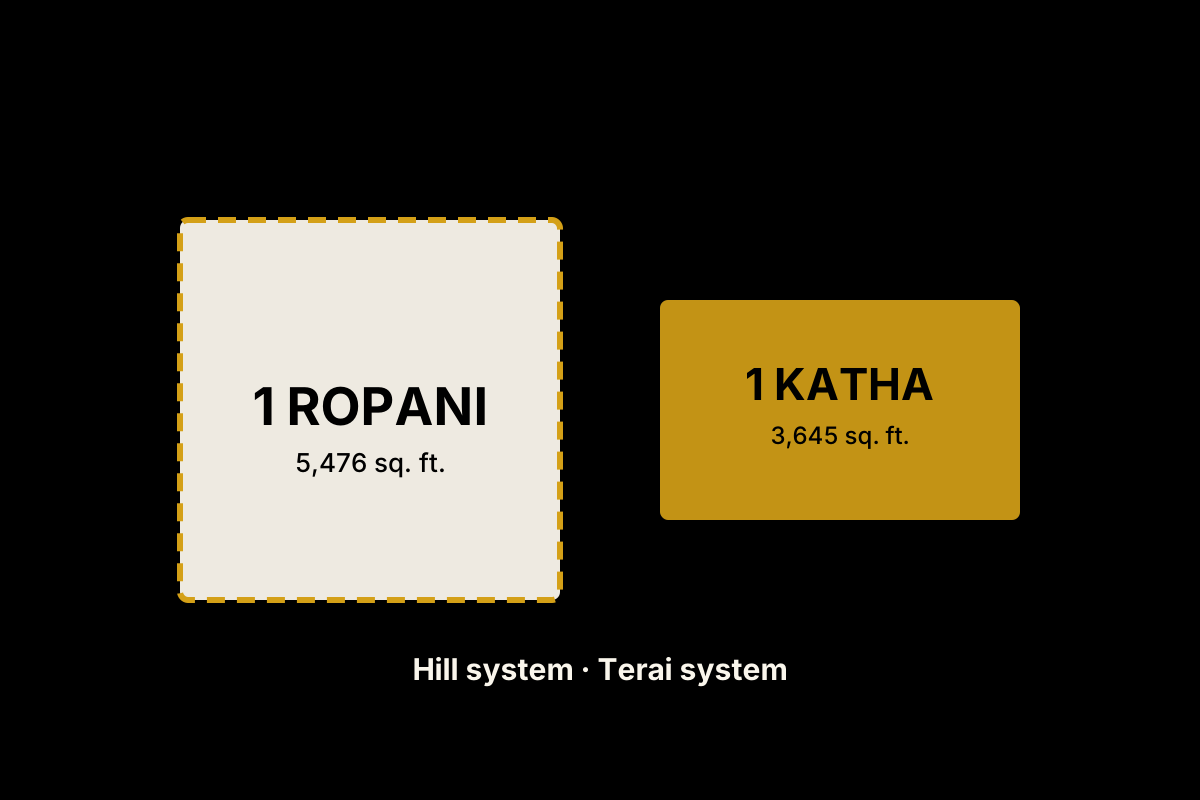
| 1 Ropani | 16 Aana | 5,476 | 508.72 |
| 1 Aana | 4 Paisa | 342.25 | 31.80 |
| 1 Paisa | 4 Daam | 85.56 | 7.95 |
| 1 Daam | — | 21.39 | 1.99 |
Land here is written in a four-part shorthand: 2-8-1-0 means 2 Ropani, 8 Aana, 1 Paisa, 0 Daam. In Kathmandu Valley, where plots are small and prices are high, most residential land is quoted and priced in Aana alone.
The Terai system: Bigha, Katha, Dhur
Used across the plains — Chitwan, Rupandehi, Morang, Sunsari, Jhapa, Parsa, Dhanusha, Banke, Kailali and their neighbours. The parcels are larger and so are the units:
| Unit | Equals | Square feet | Square metres |
|---|---|---|---|
| 1 Bigha | 20 Katha | 72,900 | 6,772.63 |
| 1 Katha | 20 Dhur | 3,645 | 338.63 |
| 1 Dhur | — | 182.25 | 16.93 |
The shorthand works the same way: 1-5-10 is 1 Bigha, 5 Katha, 10 Dhur. Terai commercial and residential land is usually priced per Katha; agricultural land is often priced per Bigha.
Putting them next to each other
The two systems do not convert into round numbers, which is why people get them wrong.
| Hill unit | Square feet | Roughly equals |
|---|---|---|
| 1 Ropani | 5,476 | 1.5 Katha |
| 1 Aana | 342.25 | 1.88 Dhur |
| 1 Bigha | 72,900 | 13.31 Ropani |
| 1 Katha | 3,645 | 10.65 Aana |
The mistake that costs money
Here it is, and it happens constantly: a buyer compares a Kathmandu plot at "30 lakh per Aana" with a Chitwan plot at "30 lakh per Katha" and concludes the two are similarly priced.
They are not remotely. One Katha is 3,645 square feet; one Aana is 342.25. The Chitwan plot is priced at roughly 2.8 lakh per Aana-equivalent — about a tenth of the Kathmandu land. Always normalise to square feet before you compare anything across districts.
Built-up area is a different measurement
One more distinction worth holding onto. Land area and built-up area are separate numbers and are quoted in different units. A house advertised as "4 Aana, 2,450 sq. ft." sits on 1,369 square feet of land and has 2,450 square feet of floor area spread over its storeys. Neither number tells you the other.
What to ask on site
- Which system does the Lalpurja use, and does the figure on it match what the seller told you?
- Is the quoted area the registered area or a measurement someone took with a tape?
- For a house: is the built-up figure the carpet area, the plinth area, or the total including the stair head and terrace?
- For an apartment: does the quoted square footage include the common-area share?
Ask them plainly. A seller who cannot answer precisely has not read their own paperwork, and that is worth knowing before you talk about price.