Where valley demand is actually moving — and what each of these five areas costs, offers and risks. Written from transactions we have handled, not from advertising.
Every few years a new part of the valley gets described as the next big thing, usually by whoever is holding land there. What follows is drawn from transactions we have actually closed over the past three years, with the drawbacks included, because a growth story without its risks is a sales pitch.
1. Budhanilkantha and Chunikhel — north edge, established premium
The northern rim has been expensive for a decade and remains so, but the character of demand has shifted. Where buyers once wanted a weekend house with a view, they now want a primary residence with clean air, and they are willing to accept the commute to make it work.
Residential land in the Chunikhel and Narayanthan belt has been trading in the range of 22 to 35 lakh per Aana depending on road width and position, with completed family houses on 4 Aana between 3 and 4.5 crore.
The risk
Water. Boring depth in parts of Budhanilkantha has increased noticeably, and the municipal supply does not reach every tole. Confirm the water source physically before you commit — and if you can, visit in Chaitra rather than Shrawan.
2. Tokha and Dhapasi Height — the value case in the north
Tokha has absorbed a lot of the demand that Budhanilkantha priced out. Road widening on the Tokha corridor and the arrival of hospitals in the Dhapasi area made the difference, and the tole structure is more settled than the newer developments further out.
Land in the Dhapasi Height area has been moving around 26 to 30 lakh per Aana, with interior plots on narrower roads lower. Apartments here are the valley's most active sub-crore segment.
The risk
Access roads vary sharply within short distances. A plot on a 16-foot gravel lane and a plot on a 20-foot blacktop three hundred metres away are different assets at different prices, and photographs will not tell you which you are looking at.
3. Tikathali, Lubhu and the Gwarko corridor — southern valley
The stretch between Gwarko and Lubhu filled in quickly after the road widening and has matured into a genuine mixed residential belt. It suits buyers who work in Lalitpur or the southern ring road and want to stay under two crore for a plot.
Recent Tikathali transactions have clustered in the 20 to 27 lakh per Aana range, with corner and main-road plots at the top of it.
The risk
A meaningful share of land in this belt is still held on undivided family title. Ask specifically whether kitta katta is complete and ask to see the resulting Lalpurja.
4. Suryabinayak and Sipadol, Bhaktapur — the affordability story
Bhaktapur remains the valley's answer for buyers who want a new house rather than a plot and cannot reach Kathmandu pricing. New four-bedroom construction on 3 to 4 Aana has been available between 1.9 and 2.4 crore — numbers that no longer exist in the northern valley.
The Bhaktapur–Nagarkot road widening reduced the practical commute considerably, and the tole infrastructure around Sipadol has improved with it.
The risk
Construction quality across the newer Bhaktapur stock is uneven. Insist on the building permit and completion certificate, and if you are not confident reading a structure, pay an engineer for two hours of their time.
5. Dhulikhel and Banepa — outside the valley, inside the commute
Not the valley, but increasingly part of its market. The Banepa–Bardibas highway and the presence of Kathmandu University and Dhulikhel Hospital give this belt something most peripheral areas lack: a local economy and a rental base that exists independently of Kathmandu.
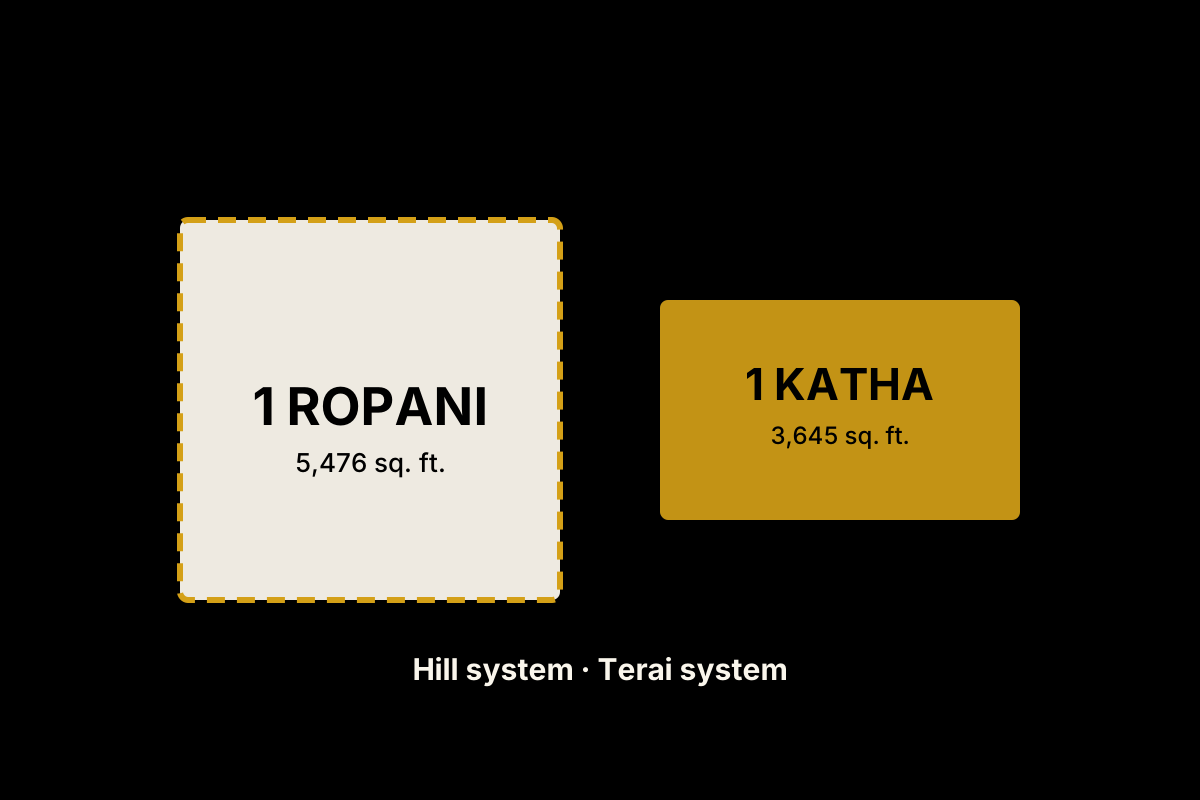
Land on the ridge roads above Dhulikhel has been trading between 50 and 70 lakh per Ropani — roughly 3 to 4.5 lakh per Aana-equivalent, a fraction of valley pricing, with mountain views valley plots cannot offer.
The risk
This is a hold, not a trade. Liquidity is thinner than in the valley and the buyer pool for a resale is smaller. Purchase it because you intend to build on it, not because you expect to flip it in eighteen months.
The unglamorous conclusion
Across all five areas the single largest driver of price difference within the same tole is not the view or the facing direction. It is road width and surface. A 20-foot blacktop frontage against a 12-foot gravel lane routinely accounts for a 20 to 30 per cent difference in value on otherwise comparable plots.