Run the arithmetic rather than the received wisdom. Yields, opportunity cost, transaction friction — and the four situations where each option is clearly the right one.
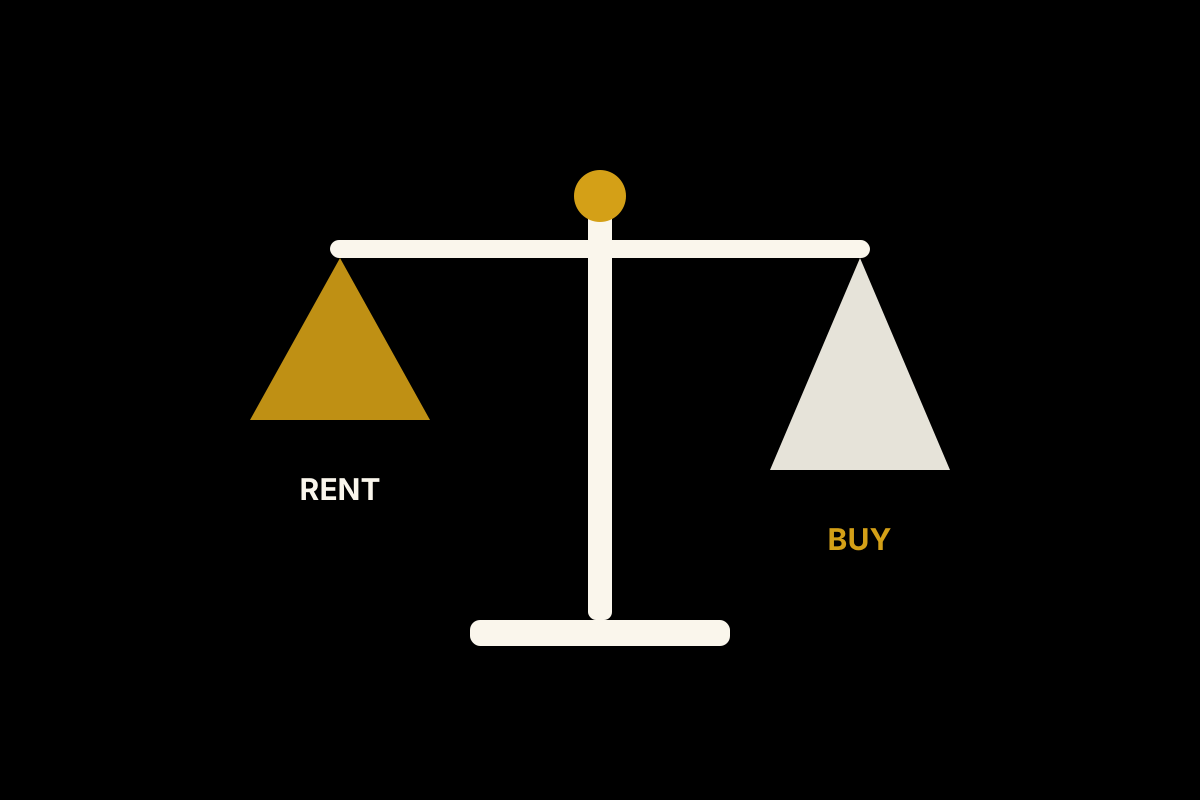
The received wisdom in Nepal is that rent is money thrown away and buying is always right. Like most received wisdom it is true in some circumstances and expensively wrong in others. Here is the arithmetic.
What the yields say
Take a familiar case: a 2BHK apartment in the northern valley at around 88 lakh, which would let for roughly 24,000 a month in the same tole. That is 2,88,000 a year gross, or about 3.3 per cent of the purchase price. After maintenance, occasional vacancy and repairs, call it under 3 per cent net.
A fixed deposit at a Nepali commercial bank has recently paid materially more than that on the same capital, with no maintenance committee and no tenant. Purely as an income asset, valley residential property is not compelling at current price-to-rent ratios.
That is not the whole case for buying — capital appreciation, security of tenure and the ability to modify a home you own are all real. But it does mean the "rent is wasted money" argument does not survive contact with a calculator.
Transaction friction is high here
Buying and selling in Nepal is expensive in both money and time. Registration fees, capital gains on exit, agent commission, deed costs, and a sale process that commonly takes three to six months for a genuine property fairly priced.
That friction sets a minimum holding period. If there is a reasonable chance you will move city, move country, or need the capital within five years, the round-trip costs will likely exceed anything you gain.
The case for renting
- Your horizon is under five years. Transaction costs dominate. Rent.
- Your work location is unsettled. A commute you chose is fine; a commute you inherited from a mortgage is not.
- You would be stretched to the maximum instalment. A loan sized to your best month is a problem waiting for your worst one.
- You want to learn a neighbourhood first. Renting in a tole for a year teaches you about water, road flooding and noise more reliably than any viewing.
The case for buying
- You are staying ten years or more. Time dissolves the transaction costs and the instalment stops moving while rents do not.
- Rent increases are outpacing your income. Annual escalation of around ten per cent is common in the valley; a fixed principal is protection against that.
- You need certainty of tenure. Families with school-age children, or anyone who has been asked to vacate at short notice, price this highly and are right to.
- You have the deposit without stripping your reserves. Thirty to forty per cent down, registration costs, and six months of expenses still in the bank afterwards.
A worked comparison
Same 88 lakh apartment. Buying with 35 per cent down means about 30.8 lakh of your own capital, a 57.2 lakh loan, and an instalment in the region of 50,000 a month over twenty years at prevailing rates — plus maintenance of 3,200 and the repairs an owner absorbs.
Renting the equivalent unit costs about 24,000 a month, and the 30.8 lakh you did not spend on the deposit earns a return elsewhere.
On monthly cash flow, renting wins comfortably today. Buying wins when — and only when — capital appreciation plus the principal you are repaying plus rent inflation you have avoided outweigh that gap. Over ten to fifteen years in a good location, it usually does. Over three, it almost never does.
The honest summary
Buy when your horizon is long, your deposit is comfortable and you have chosen the location deliberately. Rent when any of those three is missing.
We would rather tell you to rent for two years and buy well than sell you something now. The commission on a hurried purchase is the same as on a considered one; the outcome for you is not.